
The Magica vs ChatGPT comparison mainly comes down to how each platform handles AI access. Magica combines multiple AI tools, including chat, image, and voice generation, under one credit-based subscription. ChatGPT uses fixed subscription tiers for direct access to OpenAI models. If you want several AI tools in one place, Magica may offer more variety; if predictable pricing and direct model access matter more, ChatGPT is the simpler option. On price, Magica runs from $14.99/month (Hobby) to $200/month (Max), while ChatGPT starts at $8/month (Go).
| Tool | Best For | Price | Standout Feature |
|---|---|---|---|
| Magica | Users who want multiple AI tools in one bundle | Starts at $14.99/month | Combines chat, image, and voice generation under one credit pool |
| ChatGPT | Users who want direct, predictable model access | Free tier available; Go plan runs $8/month | Native GPT-6 access with no credit-sharing across tools |
What Is Magica (Formerly Galaxy.ai)?
Magica is a SaaS bundle that packages access to multiple third-party AI models and generators under one subscription rather than building its own foundation model. The platform sits in a different category than a single-vendor AI writing tool: instead of training and hosting its own large language model, it resells metered access to models like GPT-5.6 alongside Midjourney-style image generation, all metered through one credit pool.
Most people searching for a magica ai review want to know what they’re actually buying: not a proprietary model, but convenience. One login, one bill, and a shared credit balance that draws down every time a task runs, whether that’s a blog draft, a product description, or an image render. For someone who currently juggles separate subscriptions to a chatbot, a copywriting tool, and an image generator, that consolidation is the main selling point.
Where this gets more complicated is usage caps, because every tool draws from the same pool. A single high-resolution image render can use up the credit equivalent of several long-form chat replies, so a user who spends an afternoon generating product images may find text generation running low for the rest of the billing cycle. That dynamic, and how it plays out in actual subscriber accounts, is covered in more detail in the credit-system breakdown further down this comparison.
Pros
- One subscription replaces several separate AI tool subscriptions
- Access to multiple model types (text, image) without separate sign-ups
- Useful for non-technical users who want a single dashboard instead of managing API keys
Cons
- Shared credit pool means heavy image generation can starve text-based tasks
- No proprietary model, so output quality depends on whichever underlying model is available that month
- Effective cost per use can exceed a direct subscription once credits run low
Because the rebrand from Galaxy.ai to Magica is recent, many independent reviews, forum threads, and rating pages still reference the platform by its former name, worth keeping in mind when weighing outside opinions on pricing and reliability.
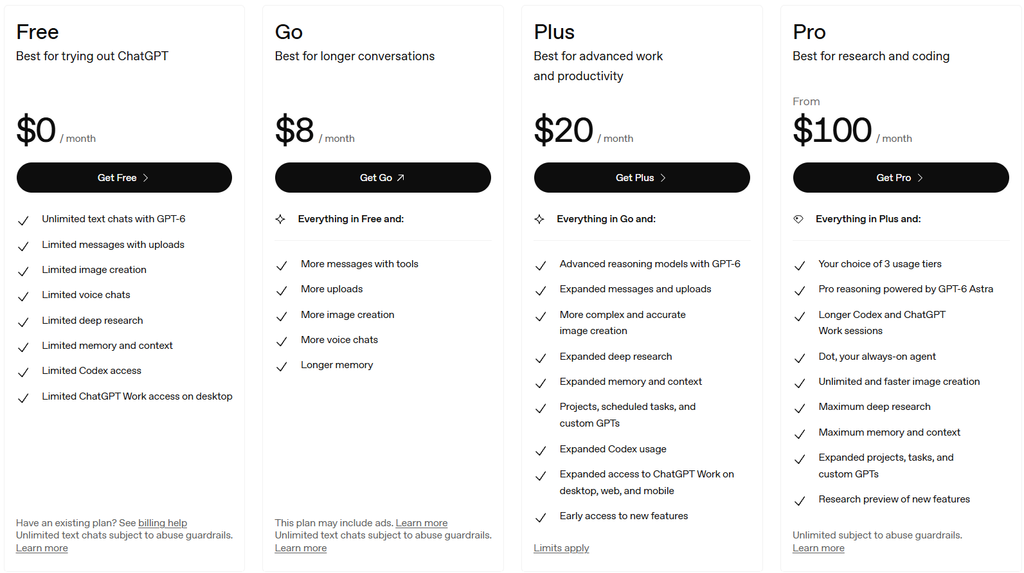
CHATGPT PRICING
MAGICA PRICING
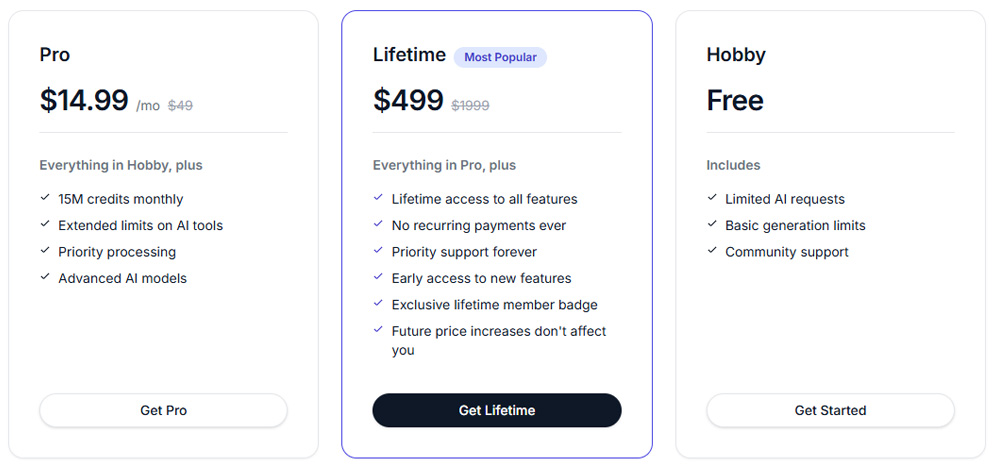
ChatGPT and Magica pricing compared, showing the difference between flat-rate plans and credit-based pricing.
Is Galaxy.ai Legit, or Is Magica a Scam?
Short answer: yes, it’s a real company. It takes payments, gives you tool access, and has thousands of paying users leaving reviews under their own names. That’s the easy part of the question.
The harder part is what happens after you sign up. In May 2026, Galaxy.ai rebranded to Magica, adding an “AI Super Agent” feature on top of its existing tool bundle. Same company, same account, same credits, per Magica’s own help page. If you’re researching “galaxy.ai” today, you’re really researching Magica.
As of November 2026, Magica’s Trustpilot page (which now also covers the old Galaxy.ai profile) shows a 4.2 TrustScore from 1,538 reviews. That’s a solid number for a company this size, and it hasn’t spiked or crashed suddenly, which is a decent sign against the “fake reviews” theory. But read past the star rating and a pattern shows up fast: happy reviews tend to come from people in their first week or two. Frustrated reviews tend to come from people who’ve been in a billing cycle long enough to watch their credits run dry.
One small, verifiable detail worth knowing: Magica’s own site hosts a page called “Free TrustPilot Review Generator,” a tool that writes review-style text for other businesses to use as a starting point. It’s a marketing product, not proof of anything shady on Magica’s own Trustpilot page. But if you’re the type of person Googling “is galaxy.ai legit,” it’s the kind of detail worth knowing exists.
So where does the $50 to $200 a month figure come from?
Two write-ups get cited a lot when people ask this question, and both deserve a second look before you trust their numbers.
The first is a Krater.ai blog post claiming that some Galaxy.ai users spend $50–$200+ per month after heavier usage and top-ups, rather than staying at the advertised $14.99 entry price. Worth knowing upfront: Krater.ai is a direct competitor. The same post spends much of its word count promoting Krater.ai as a cheaper alternative. The $50–$200+ figure should therefore be treated as a competitor estimate, not a verified average, because the post does not provide an independently checkable source for that specific spending range.
The second is a piece from AI Detect Plus, published March 30, 2026, which says the free tier offers limited requests and that support runs mostly through a community forum instead of a dedicated team. Same pattern here: AI Detect Plus sells its own AI writing tools and spends the second half of the article pushing you toward its own product. Again, the underlying complaint about support and free-tier limits lines up with what actual users say on Trustpilot, but the article isn’t a neutral third party.
What I could not verify: claims about a specific Reddit thread on r/vibecoding. I looked. Nothing turned up solid enough to cite as fact, so I’m leaving it out rather than repeating something I can’t stand behind. G2’s actual review page for Galaxy AI, by contrast, does check out, and is covered in detail further down.
What real, named users actually say
Skip the marketing blogs and read Trustpilot directly, and you get a clearer picture. A few examples, verbatim from named reviewers:
One user described being blocked from using the chat feature despite having 45 million credits remaining, saying failed generations still burned credits and that support was “basically non existent.” Another, writing after the Magica rebrand, said a simple task now takes ten minutes and called the change “absolutely horrible.” On the other side, a long-time user wrote that the transition from Galaxy to Magica was smooth and that the platform “has only improved over time.”
That split is the honest picture: people using it lightly tend to be fine. People running it hard, especially on video or image generation, hit the credit wall and get frustrated fast, and support response times seem to be the recurring sore spot regardless of which side of that split someone lands on.
The real answer
Galaxy.ai, now Magica, is not a scam. It’s a legitimate aggregator with real infrastructure and a real support queue, even if that queue is slow. The $14.99 headline price can work for light use, but heavy image and video usage can push costs much higher. If you’re generating video or images regularly, budget for the higher end of what actual users report, not the homepage number.
Pros
- Confirmed paying user base with a stable, non-spiking Trustpilot history (1,538 reviews, 4.2 TrustScore, as of November 2026)
- One login for access to multiple AI models instead of stacking separate subscriptions
- Rebrand to Magica kept existing accounts, credits, and history intact rather than forcing a migration
Cons
- Some third-party reports suggest regular users may spend more than the advertised $14.99/month, particularly with heavier usage.
- Named Trustpilot reviewers report credits draining on failed generations, not just successful ones
- Support is largely community-forum based, and named reviewers report multi-day waits with no response
How Does Magica’s Credit System Actually Work?
Magica charges by credit rather than by seat: every plan grants a fixed monthly credit pool, and each action, chat, image, or video, draws down that pool at its own rate rather than one flat per-message cost. That per-action variability, not the headline price, drives the gap between advertised and real spend covered above.
Magica’s plan pages do not publish an exact per-action rate card, so the numbers below are an estimate built from dividing each tier’s total monthly credits by its listed generation caps, not figures Magica states outright. On that basis, a short text reply appears to cost around 1 credit, a longer response on a 1,000-word prompt lands closer to 5-8 credits, and a single image render runs an estimated 15-20 credits. On the entry plan, a user running a handful of image generations a day could burn through a full month’s allotment in under two weeks, before touching chat features at all.
The credit model behaves less like a flat subscription and more like a prepaid meter. Text-heavy users may rarely notice the ceiling, since chat replies use only a few credits at a time. Anyone doing regular image or video generation hits the wall fast, which matches the pattern described in Krater.ai’s review of the platform. The credit system itself isn’t broken. It’s built for light use, and the $14.99/month entry price assumes exactly that.
Magica vs ChatGPT: Pricing Comparison
Magica pricing starts at $14.99/month for the Hobby plan and rises to $100/month (Pro) and $200/month (Max), while ChatGPT’s Go tier lists at $8/month for direct access to GPT-6. The two structures aren’t directly comparable on sticker price alone, because one sells a shared credit pool and the other sells a seat.
Magica pricing in 2026: Hobby, Pro, Max, Teams and Lifetime
According to Magica’s own pricing page, the Hobby plan is $14.99 per month for 15M credits. Pro is $100 per month for 100M credits and adds priority access at busy times. Max is $200 per month for 200M credits and adds early access to new features. Teams costs $15 per user per month. Magica also lists a one-time Lifetime plan at $499 (down from $1,999) with 15M credits a month plus 100M bonus credits at purchase, but it labels this a Black Friday offer that is not sold the rest of the year. The page also shows a 17% saving for annual billing. We checked it in November 2026, so confirm current prices before you buy.
The table below lines up list price against what that price actually buys, since credit depletion is the variable that changes the real cost per use.
| Plan | List Price | What You Get | Top-Up Risk |
|---|---|---|---|
| Magica Hobby | $14.99/mo | 15M credits per month across chat, image, and video tools | High, based on independent user reports questioning whether the base tier covers regular use |
| Magica Pro | $100/mo | 100M credits per month, plus priority access at high traffic times | Moderate, depends on output mix |
| Magica Max | $200/mo | 200M credits per month, plus early access to new capabilities | Moderate, depends on output mix |
| Magica Teams | $15/user/mo | Team workspace, centralized billing, and an admin dashboard with usage stats | Depends on seats and usage |
| Magica Lifetime | $499 one-time (Black Friday only) | 15M credits per month, plus 100M bonus credits at purchase | Same 15M monthly pool as Hobby, so heavy users may still run short |
| Free | $0 | Limited GPT access with usage caps | None (hard cap, no billing surprise) |
| Go | $8/month | Broader GPT-6 access, more messages, uploads, and image creation than Free | None, no credit metering |
| Plus | $20/month | Advanced GPT-5.6 models, higher usage limits, Codex usage | None, flat per-seat billing |
| Pro | From $100/month | 5x or 20x more usage, GPT-5.6 Sol Pro | None, flat monthly rate regardless of usage |
| Business | $20/user/month | Access ChatGPT, ChatGPT Work, and Codex on the web and through desktop and mobile apps, plus tool connectors (Microsoft 365, Google Drive, Slack, GitHub) and centralized billing | None, flat per-seat billing |
The gap between advertised and effective cost is where Magica’s pricing draws the most scrutiny. Krater.ai’s review of the platform puts real-world monthly spend between $50 and $200-plus once users top up past the base allotment, despite the $14.99 headline figure. That same complaint shows up directly on Trustpilot. One reviewer described being blocked from using chat features despite having 45 million credits remaining, saying failed generations still burned credits and that support was “basically non existent.” Another user reported having 123 million unused credits become inaccessible the moment their subscription lapsed, with no response from support after repeated attempts.
ChatGPT’s subscription plans don’t use the same shared credit-pool model, since Free, Go, Plus, Pro, and Business all bill at a fixed rate with no credit metering. Business extends that same predictability to organizations, adding centralized billing, admin controls, and workspace-wide tool connectors on top of the flat per-seat rate.
Source: Trustpilot: Magica (formerly Galaxy.ai) reviews and Trustpilot: magica.com reviews
Magica vs ChatGPT: Features Comparison
Magica vs ChatGPT features diverge less on output quality and more on breadth versus depth. Magica packages several third-party engines under one dashboard, so writing, image generation, and basic coding support sit behind a single login. ChatGPT concentrates everything inside OpenAI’s own model family, trading tool variety for more consistent behavior across a narrower feature set.
Coding tasks show the split most clearly. Debugging a multi-file Python script is a useful test case: ChatGPT’s built-in code interpreter can execute the code in a sandbox, read the actual traceback, and revise the fix in the same turn. Magica’s product page lists its coding tool as code generation only, with no sandbox or execution environment mentioned as of August 2026. That gap means the same debugging session requires copying output into an external IDE and manually feeding errors back in.
Image generation shows a smaller but real gap in prompt fidelity. ChatGPT’s native image tool tends to hold onto specific instructions, like exact object counts or in-image text, across follow-up edits in the same conversation. Magica’s bundled generator produces comparable first-pass output, but its follow-up edits route through a separate API call rather than a single persistent session, which can affect consistency on iterative requests. This is a structural difference in how the two are built, not a documented complaint from a specific source.
| Capability | Magica | ChatGPT |
|---|---|---|
| Writing / chat | Multiple model options (GPT-5.6 class) via credit draw | Native GPT-5.6 class access, flat-rate |
| Image generation | Midjourney-style rendering bundled in; follow-up edits reported as less consistent | Native image generation with in-session context carried across edits |
| Research / browsing | Available, inconsistent depth across sessions | Native web browsing, tightly integrated |
| Coding | Generates code but does not execute it; no built-in sandbox listed as of August 2026 | Built-in code interpreter runs code and iterates on errors in the same session |
| Tool count | Dozens of bundled generators and templates | Single model family, fewer standalone tools |
| Model depth | Broad but shallower per-tool tuning | Deep, consistent tuning within one model line |
The name overlap causes its own confusion: shoppers who search “magica vs chatgpt features” sometimes land on unrelated results for a different product that happens to share the same name, rather than this software company’s comparison pages, since the naming overlap is coincidental rather than connected.
Does Magica Give You Real Access to ChatGPT and Midjourney?
Magica connects to third-party APIs rather than reselling a native ChatGPT Plus or Midjourney subscription, so you get model outputs without the native apps, memory features, or community tools those platforms build around them. Magica’s own help center confirms the underlying mechanics changed name but not structure when Galaxy.ai became Magica in May 2026: same credits, same account, same routing setup, just a new front end and an added “Super Agent” feature.
What gets lost in a wrapper model like this is worth naming plainly. ChatGPT Plus retains memory across sessions, recalling a user’s writing style or project details weeks later, a feature built into OpenAI’s own product. Midjourney subscribers get a Discord-based community feed for browsing and remixing prompts. Magica’s bundled tools produce similar-style output but without either of those native layers, since the requests route through separate API calls rather than a persistent account with either underlying company.
That distinction matters for anyone comparing it to a flat-rate AI writing tool. A direct ChatGPT subscription gives fixed monthly access to OpenAI’s models with no resharing of quota. Magica’s wrapper model means effective cost per use shifts with credit consumption rather than a flat token limit. This is also why it is worth not confusing the brand with a phone-based voice assistant with no connection to this SaaS bundle, or with Google’s Gemini, which is a separate foundation model entirely.
Pros
- Single login gives access to multiple third-party engines instead of separate subscriptions
- Useful for casual users who want to sample GPT-5.6 output and Midjourney-style images without paying for each separately
- No need to manage separate API keys or developer accounts
Cons
- No native ChatGPT memory across sessions, no Midjourney Discord community feed, and no plugin or app integrations tied to either original platform
- Credit-based routing means heavier users can burn through allowances faster than a flat-rate plan
- Trustpilot and G2 reviewers question whether the advertised $15/month price reliably covers meaningful usage.
Source: Magica help center: “Galaxy is rebranded as Magica”
What Do Galaxy AI Reviews Actually Say?
Magica reviews (the product was called Galaxy AI until May 2026) split into two clear camps: people who like having several generators behind one login, and people annoyed at how quickly credits run out once a real workload starts. The pattern shows up clearly on the Trustpilot page for magica.com, where the praise and the complaints tend to come from the same reviewers rather than two separate groups.
One Trustpilot reviewer described liking the range of tools at first, then getting blindsided mid-project when the credit balance ran dry, forcing an upgrade before a client deadline could be met. That pairing, satisfaction with variety alongside frustration at pacing, repeats across several reviews on the page rather than appearing as an isolated complaint. It’s a different failure mode than a broken feature: the tools work, but the budget math doesn’t hold up under sustained use.
G2 tells a smaller but sharper story. Galaxy AI’s G2 page shows just two reviews, averaging 0.5 out of 5, both filed after the Magica rebrand. One reviewer documented six months of use and roughly 70 million credits consumed, reporting that failed generations still drew down credits and that support never responded to repeated emails; he was eventually offered 15 million credits back against more than 60 million he says were lost to broken outputs. The other reviewer put a number on the render cost directly: a 15-million monthly credit allotment against renders that can each cost 0.5 to 2 million credits. Two reviews is too small a sample to treat as a trend on its own, but both are detailed, dated, and consistent with the credit-depletion pattern showing up on Trustpilot.
Pros
- Reviewers consistently mention the convenience of reaching multiple generators from one dashboard
- Entry-level pricing draws favorable first impressions before heavier usage kicks in
- Trustpilot’s review volume gives buyers a reasonably large sample to read before signing up
Cons
- Several Trustpilot reviewers describe upgrading tiers earlier than planned once credits ran short mid-project
- G2’s thin review count makes it a weak signal for judging day-to-day satisfaction
- Complaints about pacing and credit burn show up often enough to treat as a pattern, not a one-off
Which Is Better for Content Creation: Magica or ChatGPT?
Magica works better for high-volume, mixed-format content: captions, product blurbs, quick image mockups, where one login covering text and visuals saves a second subscription. ChatGPT Plus suits creators doing sustained, single-format writing, research, or multi-step strategy work, since a flat-rate chatbot doesn’t force a tradeoff between output volume and remaining budget.
Single-vendor chatbots typically hold conversational context better across long sessions than a shared, multi-tool interface, which matters when outlining a 3,000-word guide or revising a content calendar over a dozen back-and-forth turns. A credit-based tool is built for the opposite pattern: short, high-frequency tasks where per-unit cost matters more than sustained context.
Here’s the math in simple terms: drafting 10 short product descriptions, each under 100 words, would generally represent a light text workload compared with image generation or longer-form content. On Magica, the cost depends on how many credits those tasks consume from the $14.99 plan. On ChatGPT Plus, the same type of work is covered by the flat $20 monthly subscription, making the cost easier to predict. The difference becomes more noticeable when a project adds image generation, longer articles, or multiple rounds of revisions.
Pros
- Covers text and image generation under one subscription, useful for creators who need both
- Lower entry price fits creators with lighter, task-based workloads
- Good fit for batch content like captions, descriptions, and quick visuals
Cons
- Credit pool drains quickly on long-form or research-heavy sessions
- Less suited to sustained, multi-turn strategy work than a direct chatbot subscription
- Real monthly cost can exceed a flat-rate plan for heavy writers
Final Verdict: Magica or ChatGPT?
The Magica vs ChatGPT comparison comes down to two different budgets and two different workflows. One sells breadth at a variable cost per action, the other sells depth at a fixed monthly price. ChatGPT also remains the most visited AI assistant, with 56.4% of AI chatbot web visits in September 2026 according to Similarweb (see our AI race tracker), so tutorials and community help are easy to find.
| Category | Winner | Why |
|---|---|---|
| Sticker price | ChatGPT | $8/month is cheaper than Magica |
| Predictable monthly cost | ChatGPT | Flat rate regardless of tier, no credit math, no mid-cycle surprises |
| Writing depth | ChatGPT | direct GPT-5.6 access, no wrapper lag |
| Image generation variety | Magica | bundles Midjourney-style rendering in one login |
| Model variety | Magica | multiple engines under one dashboard |
| Support quality | ChatGPT | direct vendor support vs community-only threads |
| Transparency of billing | ChatGPT | fewer Trustpilot complaints about hidden usage caps |
Choose Magica if…
- you need writing and image tools in one login for under $20/month
- your monthly output is light enough to stay inside the entry credit pool
- you’re testing multiple AI engines before committing to one vendor
Choose ChatGPT if…
- you write daily and need predictable, uncapped-feeling access to GPT-5.6 class models
- you value direct vendor support over community forums
- you’d rather budget one flat fee than track credit burn
- you want a flat-rate option cheaper than Magica’s entry tier, ChatGPT Go starts at $8/month
Anyone leaning toward the bundle should read the Trustpilot and G2 reviews on credit depletion before paying for a full month. Check both official pricing pages directly, start on the lowest tier or a free trial, and run a typical week of prompts against it before upgrading. Heavy daily writers who dislike surprises should stay with ChatGPT’s flat rate.
The clearest number to keep in mind is Magica’s Trustpilot rating: 4.2 out of 5 from about 1,540 reviews as of November 2026. That score reflects real satisfaction with the range of tools, alongside a recurring complaint pattern about how fast credits disappear once light chat use turns into image or video generation.
Frequently Asked Questions
How much does Magica cost?
Magica costs $14.99 per month for Hobby, $100 per month for Pro, and $200 per month for Max, according to its pricing page. Teams is $15 per user per month. A one-time Lifetime plan at $499 is listed as a Black Friday offer only. Credits are the real limit, so heavy image or video use can use up a plan quickly.
Is Magica AI free?
Magica’s pricing page currently lists paid plans only. The lowest is Hobby at $14.99 per month. If Magica offers a trial or promotion, it will be shown on its own site, so check there before you pay.
Is Galaxy.ai legit, or has it been replaced by a scam site?
Galaxy.ai is legit and still operating, just under a new name: Magica, following a 2026 rebrand. Its Trustpilot profile confirms the transition and describes the product as an AI agent with app and browser connectors. Access to bundled models is real, though the credit ceiling on entry plans is tighter than the advertised price suggests.
Why do some Reddit threads call Galaxy.ai a scam?
Most complaints trace back to credit depletion, not fraud. Named reviewers on Trustpilot describe running out of credits mid-project, being blocked from chat features despite having tens of millions of credits remaining, and losing access to paid-for, unused credits after a subscription lapsed. That pattern shows up once users move from light chat use into image or video generation, which burns credits far faster than text prompts. It’s a billing-design complaint, not evidence of fraud.
Do unused Magica credits roll over to the next billing cycle?
Based on user reports on Trustpilot, credit pools reset at renewal rather than carrying unused balance forward, and refunds for leftover credits after a cancellation are not typically issued. That detail matters for anyone weighing Magica against a flat-rate tool, since a light-use month effectively wastes part of the subscription instead of banking it.
Does Magica offer better value than ChatGPT for most people?
It depends on how predictable your usage is. Someone who mainly needs steady text generation gets more reliable value from a flat ChatGPT subscription. Someone who wants writing, image, and video tools under one login may still lean toward Magica, but only if they budget for credit top-ups once the base allotment runs out mid-cycle.
What do independent reviews say about Magica’s support and request limits?
AI Detect Plus published a review on March 30, 2026, noting a capped number of AI requests per cycle and support handled mainly through community channels rather than direct staff response. G2 and Trustpilot reviewers describe similar delays when a billing or credit dispute needs a human to resolve it, rather than a bot-driven help center.
Leave a Reply