Best LLM SEO Tools 2026: GEO & AEO Tracking Tools Compared

An LLM SEO tool answers one question your rank tracker can’t: when someone asks ChatGPT, Perplexity, Gemini, or Google’s AI Overviews about your category, does your brand come up? These tools run real prompts through AI models every day, then show you who gets mentioned, who gets cited, and where you’re missing. This guide compares eight of them on price, engine coverage, and who each one actually suits, so you can pick one without sitting through five sales demos.
Most “best GEO tools” articles are written by a GEO vendor that ranks itself first. We don’t sell an AI visibility product, and we explain exactly how we compared these tools (and what we didn’t do) in the methodology section below. All prices are monthly list prices checked on each vendor’s official pricing page on October 21, 2026.
| Tool | Best For | Starting Price (billed monthly) | AI Engines at Entry Tier |
|---|---|---|---|
| Otterly.AI | Solo marketers and small teams on a budget | $29/mo (Lite) | 4: ChatGPT, AI Overviews, Perplexity, Copilot |
| Peec AI | Marketing teams; separate agency plans | $95/mo brand plan; agency plans from $245/mo | 3 models of your choice |
| SE Visible | Tracking lots of prompts for less money | $99/mo ($79/mo billed annually) | ChatGPT, Gemini, Perplexity, AI Mode, AI Overviews |
| Semrush AI Visibility Toolkit | Teams already paying for Semrush | $99/mo standalone AI Visibility; $199/mo SEO + AI Starter | Google AI, ChatGPT, Perplexity, Gemini and more |
| Scrunch | Enterprise brands with security reviews | $250/mo (Core) | 4, including AI Overviews and Copilot |
| AthenaHQ | The widest engine coverage under $300 | Free tier; Starter $295/mo | 11, including Claude and Grok |
| Profound | Large companies where AI visibility is a board metric | Free 7-day trial; then custom | Up to 9 on Enterprise |
| HubSpot AI Search Grader | A free first look at your AI visibility | Free (one-time check) | ChatGPT, Perplexity, Gemini |
How We Compared These LLM SEO Tools
We want to be upfront about what this comparison is and isn’t. It is a research-based comparison of published plans. It is not a hands-on test: we did not buy paid accounts or run our own prompt tracking for this roundup, so every number below comes from vendor plan limits, not from our own measurements.
Here is what we did. On October 21, 2026, we checked each vendor’s official pricing page and recorded the cheapest paid plan at its monthly list price, noting annual discounts separately. Where a vendor sells different plans to brands and agencies, or sells AI tracking both on its own and bundled into a bigger suite, we list both. We then compared five things: the AI engines included on the entry plan, the number of prompts tracked daily, the cost per tracked prompt, whether the tool shows which sources AI answers cite, and seat limits and free trials. Finally, we read user reviews and independent comparison write-ups to find recurring complaints that pricing pages don’t mention.
If we run hands-on tests later, we’ll add the results here and update the date.
What Is an LLM SEO Tool?
An LLM SEO tool is software that measures how large language models talk about your brand. You give it a list of prompts your buyers might type, like “best CRM for a five-person sales team,” and it runs those prompts through AI engines on a schedule. Then it reports whether you were mentioned, where you appeared in the answer, how the AI described you, and which websites it cited as sources.
You’ll see the same category called GEO tools (generative engine optimization), AEO tools (answer engine optimization), AI visibility tools, or AI search optimization tools. The labels overlap almost completely. What matters is what the tool tracks and how much it charges per prompt, not which acronym is on the homepage.
Classic SEO platforms track blue-link rankings. If you want to see how those suites have added AI features on top, our best AI SEO tools comparison covers Semrush, Ahrefs, Surfer, and five others.
The 8 Best LLM SEO Tools in 2026, Compared
The biggest differences between these tools come down to three things: how many AI engines you get on the entry plan, how many prompts you can track before the price jumps, and whether seats are limited. A $29 tool and a $295 tool can both say “AI visibility tracking” on the homepage and mean very different things.
01. Otterly.AI
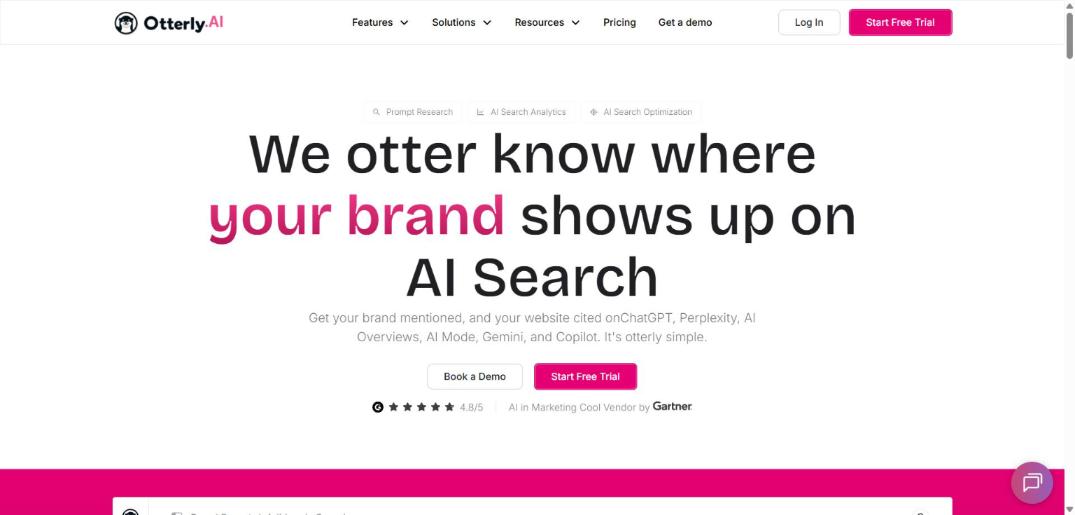
Otterly.AI is the cheapest serious option on this list. Its Lite plan costs $29 a month (15% less on annual billing) and still tracks four engines: ChatGPT, Google AI Overviews, Perplexity, and Microsoft Copilot.
The catch is prompt volume. Lite gives you just 15 prompts, and the next step up, Standard, jumps to $189 a month for 100 prompts, with Premium at $489 for 400. Every plan includes unlimited team members and daily tracking, while Claude, Gemini, and Google AI Mode are paid add-ons. If you’re a freelancer or a small SaaS team that just wants to know whether AI tools mention you at all, Otterly is where we’d start.
Pros
- Lowest entry price in the category at $29 a month
- Four AI engines on the cheapest plan, including Copilot
- Simple enough to set up in an afternoon
Cons
- Big price gap between Lite ($29) and Standard ($189)
- Only 15 prompts on Lite, and Claude, Gemini, and AI Mode cost extra
- Monitoring focused, with lighter optimization guidance than pricier tools
02. Peec AI
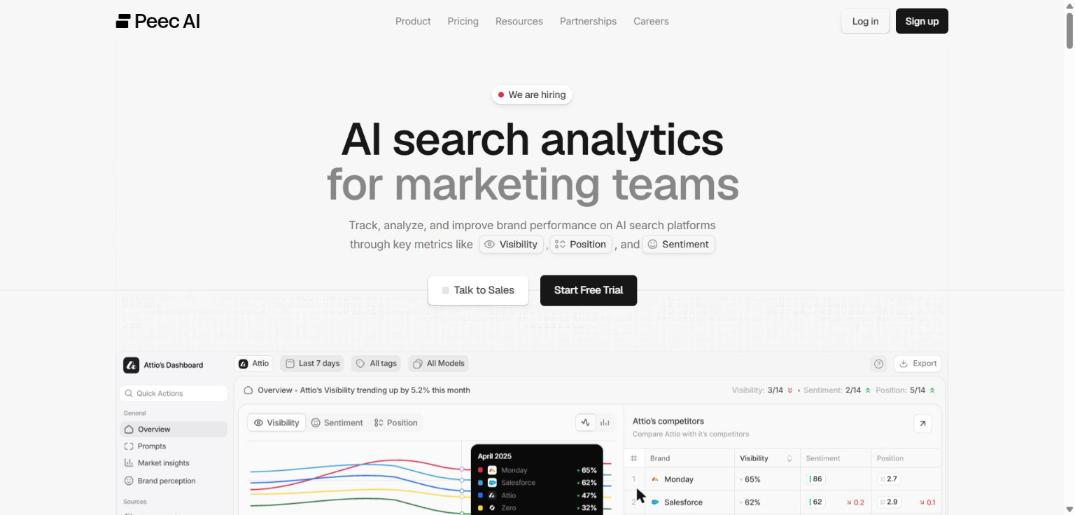
Peec AI is one of the most talked-about trackers with marketing teams, mostly because of clean dashboards and unlimited seats on every plan. Starter costs $95 a month for 50 prompts across three AI models you choose. Pro is $245 a month for 150 prompts, and Advanced is $495 a month for 350 prompts.
Every plan includes daily tracking and three models of your choice. Starter covers one project, Pro covers two, and Advanced covers five, adding multi-country tracking and a Looker Studio integration. Adding a fourth model costs extra, and choosing from all models (Claude included) is reserved for the custom Enterprise tier. Agencies get a separate set of credit-based plans. Essential costs $245 a month for 10,000 credits, Growth costs $495 a month for 25,000 credits and is aimed at agencies with 3 to 10 clients, and Scale costs $795 a month for 65,000 credits for agencies with 11 to 25 or more clients. Agency plans add client projects, client view-only seats, and free pitch projects for prospects. So if you’re an agency, compare against the $245 plan, not the $95 brand plan.
Pros
- Unlimited seats on every plan, which helps agencies and larger teams
- Clean, shareable dashboards with sentiment and citation data
- Agency plans built around client projects
Cons
- Only three AI models included; each extra model is a paid add-on
- Claude tracking requires the Enterprise tier
- Tight project limits on lower tiers (one project on Starter)
03. SE Visible
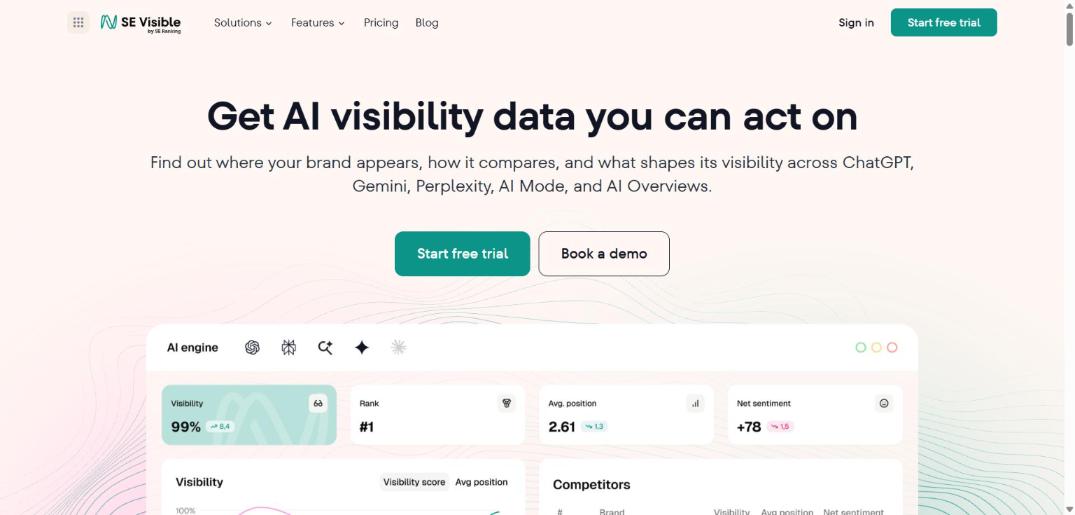
SE Visible is SE Ranking’s standalone AI visibility platform, separate from the AI tracker inside the main SE Ranking suite. Its Basic plan costs $99 a month, or $79 a month billed annually, for 200 prompts, and there is a 10-day free trial. It covers ChatGPT, Gemini, Perplexity, Google AI Mode, and AI Overviews.
That prompt count is the reason it’s here. For comparison, Otterly’s $29 plan gives you 15 prompts and Peec’s $95 plan gives you 50. If you want to track a whole topic cluster instead of a handful of hero queries, SE Visible gives you more room for the money. Just know it’s a different product from the AI Results Tracker add-on in SE Ranking, which mainly covers Google AI Overviews and AI Mode.
Pros
- High prompt allowance for the price (200 prompts on Basic)
- Competitor benchmarking and share of voice built in
- Backed by SE Ranking’s long-running search data
Cons
- Two separate SE Ranking AI products can confuse buyers
- No Claude or Copilot tracking on standard plans
- Best rate requires annual billing
04. Semrush AI Visibility Toolkit
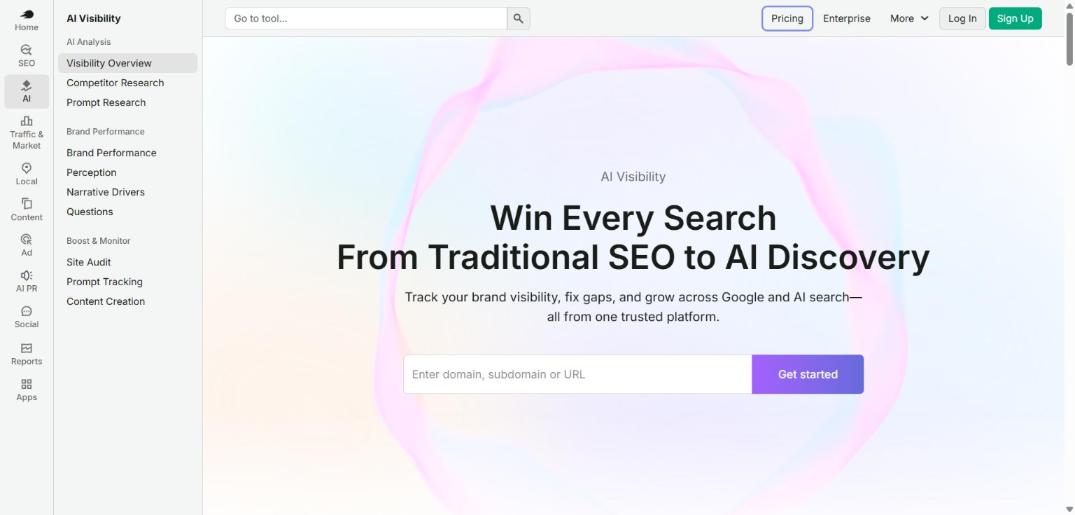
The Semrush AI Visibility Toolkit is now built into Semrush’s SEO + AI Search plans. The entry SEO plan ($139 a month, or $117.33 billed annually) does not include AI tracking. AI visibility starts on the Starter plan at $199 a month ($165.17 billed annually), which includes 50 prompts tracked daily, one domain for AI brand performance, and 300 AI visibility reports per day. Pro+ ($299, or $248.17 billed annually) raises that to 100 prompts. It shows mentions, citations, and overall visibility across AI platforms, and its standout feature is AI prompt gap analysis: it shows prompts where competitors get named and you don’t.
If your team already lives in Semrush, this is the easiest LLM SEO tool to justify, because your keyword data, site audits, and AI visibility end up in one login. If you only want AI tracking, Semrush also sells AI Visibility on its own. The Base plan costs $99 a month per domain and includes 25 prompts tracked daily, with mentions from ChatGPT, Google AI, Gemini, and Perplexity. That’s the cheaper way in if you don’t need the SEO tools, though 25 prompts is far fewer than SE Visible’s 200 at the same $99.
Pros
- AI visibility next to keyword and backlink data you already use
- Prompt gap analysis shows where competitors beat you
- AI visibility bundled with full SEO tools from the Starter plan up
Cons
- The cheapest SEO plan leaves out AI tracking, and the $99 standalone plan only tracks 25 prompts
- Built on top of an SEO suite rather than designed AI-first
- Steep learning curve if you’re new to Semrush
05. Scrunch
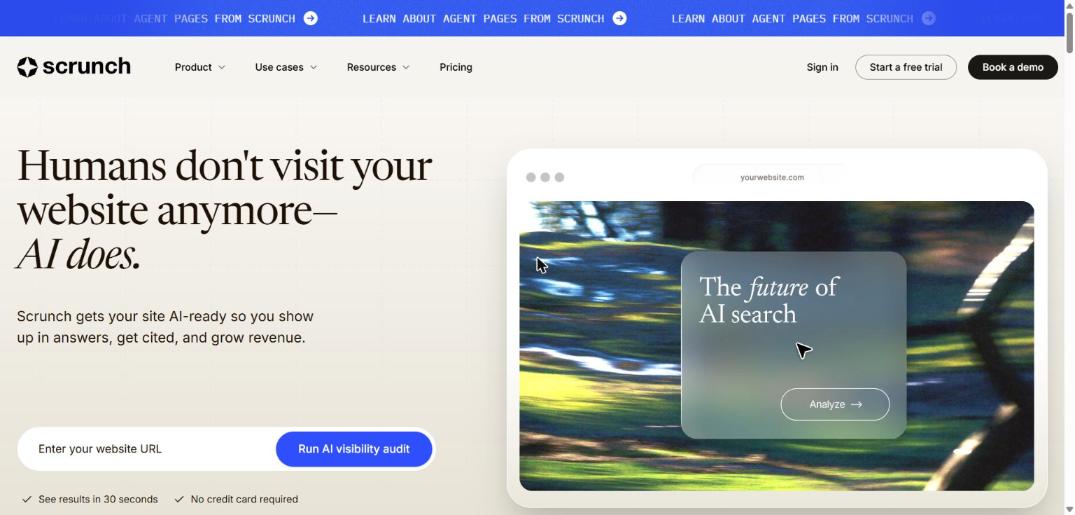
Scrunch aims at larger brands. Its Core plan costs $250 a month per brand and includes 125 prompts, 5,000 AI responses a month, five user licenses, and a 7-day free trial. It covers four engines: ChatGPT, Perplexity, Google AI Overviews, and Copilot. Claude, Gemini, and Grok are reserved for Enterprise. It goes beyond monitoring with site audits, optimization guidance, and an “agent experience” layer that serves AI-friendly versions of your pages to crawlers.
Its Enterprise plan adds SAML SSO and expanded model coverage, which matters if your legal or security team has to approve every new vendor. For a five-person startup, that’s a lot of tool. For a mid-market brand with a security checklist, it removes a blocker.
Pros
- Enterprise security options like SAML and OIDC SSO
- Monitoring, auditing, and optimization in one platform
- Covers AI Overviews and Copilot on the entry plan
Cons
- $250 entry price is high for small teams
- More setup work than lightweight trackers
- Claude, Gemini, and Grok tracking require Enterprise
06. AthenaHQ
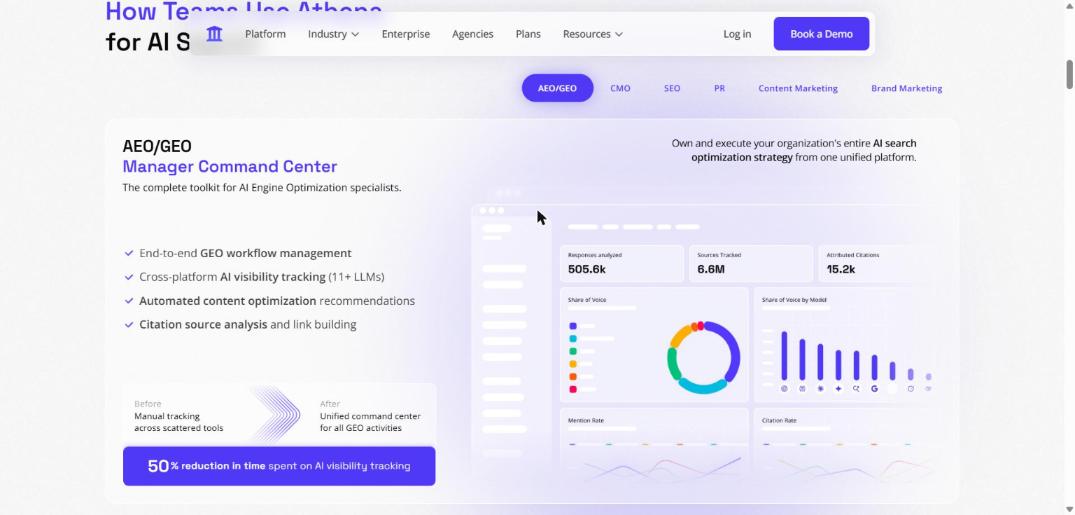
AthenaHQ covers the most engines of any self-serve plan we found. Its Starter plan costs $295 a month and tracks eleven AI engines, including Claude and Grok, with unlimited seats. Starter includes 3,600 credits a month, where one credit equals one AI response. There is also a free Essential plan with 300 credits that covers ChatGPT, Perplexity, AI Overviews, Gemini, and Copilot, which is a good way to test it first.
That makes AthenaHQ a strong AEO tool for B2B companies whose buyers use more than ChatGPT. Developers lean on Claude, some audiences use Grok, and most trackers skip both. The credit model is the thing to watch: tracking many prompts across eleven engines every day burns credits fast, so estimate your volume before signing up.
Pros
- Eleven AI engines on the entry plan, including Claude and Grok
- Unlimited seats
- Pairs tracking with optimization recommendations
Cons
- Credit-based billing makes monthly costs harder to predict
- $295 paid plan is steep for solo users, though a free tier exists
- Tracking every engine daily uses credits quickly
07. Profound
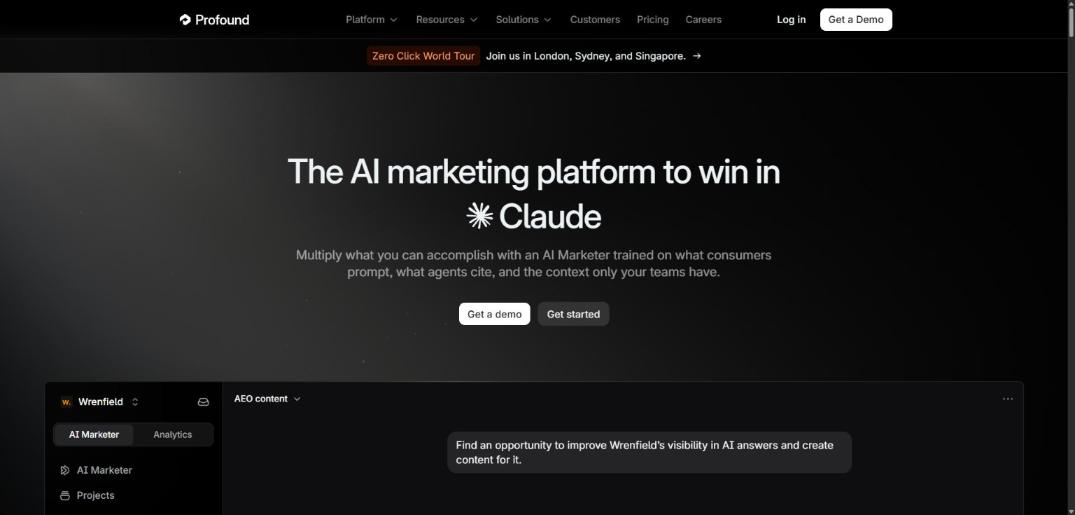
Profound is widely seen as the deepest AI visibility platform, with prompt analytics, AI crawler tracking, and credit-based agents that help act on the gaps it finds. Pricing is now simple but steep: there is a free trial, and everything after that is a custom Enterprise contract.
The free trial runs 50 prompts daily for seven days on ChatGPT, Gemini, and Google AI Overviews, with unlimited seats. After that, you need a demo and an Enterprise plan, which tracks up to nine answer engines and includes SSO and SOC 2 compliance. If you’re a large brand where a wrong AI answer costs real money, Profound is worth the call. For everyone else, the tools above cover most of what you need for a fraction of the price.
Pros
- Some of the deepest prompt and citation analytics in the category
- AI crawler and agent analytics beyond basic mention tracking
- Built for large teams running AI visibility as a formal program
Cons
- No self-serve paid plans, only a 7-day trial before Enterprise
- Enterprise pricing puts it out of reach for small teams
- Trial data covers only three engines and seven days
08. HubSpot AI Search Grader
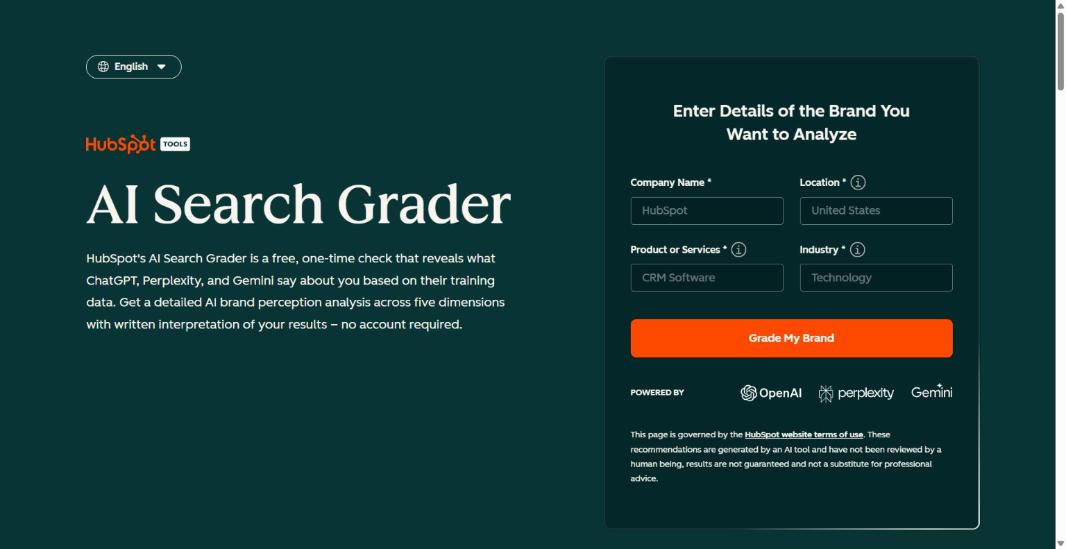
HubSpot’s AI Search Grader (formerly the AEO Grader) is a free, one-time check of what ChatGPT, Perplexity, and Gemini say about your brand, scored out of 100 across five areas, with no account required. For ongoing tracking, HubSpot also sells a paid AEO product, so check HubSpot’s pricing page for the current cost.
The free grader is the best place to start if you’ve never checked your AI visibility. It won’t give you daily prompt tracking or deep competitor data, but in five minutes it tells you whether you have a problem worth paying to solve.
Pros
- Free grader with no signup friction
- Scores your brand across five areas with a written breakdown
- Fits naturally if you already use HubSpot
Cons
- One-time snapshot, not daily tracking
- Limited prompt-level and competitor detail
- Best value only for existing HubSpot users
Cost per Tracked Prompt: LLM SEO Tools Side by Side
Headline prices hide big differences in what you get. The table below divides each plan’s monthly list price by the number of prompts it tracks daily. All prices use monthly billing so the numbers are comparable.
| Tool and Plan | Monthly Price | Prompts Tracked Daily | Cost per Prompt | AI Engines Included | Citation Tracking | Best Use Case |
|---|---|---|---|---|---|---|
| Otterly.AI Lite | $29 | 15 | $1.93 | 4 | Yes | Testing AI visibility on a small budget |
| Otterly.AI Standard | $189 | 100 | $1.89 | 4 | Yes | Small marketing teams |
| Peec AI Starter (brand) | $95 | 50 | $1.90 | 3 of your choice | Yes | One brand with clean dashboards |
| Peec AI Essential (agency) | $245 | About 111* | About $2.21 | 3 (sample setup) | Yes | Agencies winning first clients |
| SE Visible Basic | $99 | 200 | $0.50 | 5 | Yes | Tracking a large set of prompts |
| Semrush AI Visibility Base (standalone) | $99 | 25 | $3.96 | 4 | Yes | AI tracking without the SEO suite |
| Semrush SEO + AI Starter (bundled) | $199 | 50 | $3.98 | 4+ | Yes | SEO and AI visibility in one tool |
| Scrunch Core | $250 | 125 | $2.00 | 4 | Yes | Brands that also want site audits |
| AthenaHQ Starter | $295 | Credit based (3,600 responses) | About $0.08 per AI response | 11 | Yes | Widest engine coverage |
| Profound Enterprise | Custom | Custom | Not published | Up to 9 | Yes | Large enterprise programs |
| HubSpot AI Search Grader | Free | One-time check | $0 | 3 | No | A first look before paying |
*Peec’s agency plans are credit based. The prompt count is Peec’s own example for daily tracking on three models; it changes with the models and frequency you pick.
Two things to keep in mind. First, cost per prompt doesn’t account for engines: a prompt checked on four engines does more work than one checked on three. Second, AthenaHQ bills per AI response, so one prompt tracked daily on all 11 engines uses about 330 credits a month, which means Starter covers roughly 10 prompts across every engine, or more if you track fewer engines.
How to Choose the Best LLM SEO Tool for Your Team
Start with three questions. Which AI engines do your buyers actually use? (If you’re not sure, our AI race tracker shows each assistant’s share of web visits: ChatGPT, Gemini, and Claude together account for about 91%.) How many prompts do you need to track to cover your category? And how many people need access?
If you’re a solo founder or a small team testing the waters, run the free HubSpot grader first, then move to Otterly.AI at $29 if you see gaps. If you need to track a wide set of prompts without a big budget, SE Visible gives you the most prompts for the money. Agencies juggling several clients should look at Peec AI’s agency plans, which start at $245 a month. B2B and developer-focused brands that care about Claude should look at AthenaHQ. And if you already pay for Semrush Starter or higher, use its AI visibility tools before buying anything new.
One more thing: an LLM SEO tracking tool shows you the problem. It doesn’t fix it. Getting cited by AI engines still comes down to clear, specific pages that answer real questions, plus mentions on sites the models already trust.
Best LLM SEO Tools 2026: Frequently Asked Questions
What is the best LLM SEO tool for small businesses?
Otterly.AI is the best starting point for most small businesses. At $29 a month it tracks ChatGPT, Google AI Overviews, Perplexity, and Copilot. If you want more prompts for slightly more money, SE Visible costs $99 a month ($79 billed annually) for 200 prompts.
Are GEO tools and AEO tools the same thing?
Mostly, yes. GEO (generative engine optimization) and AEO (answer engine optimization) tools both track whether AI assistants mention and cite your brand. Vendors use the terms differently, so compare features and engine coverage instead of the label.
Can I check if ChatGPT mentions my brand for free?
Yes. HubSpot’s free AI Search Grader gives you a quick snapshot. You can also type your buyers’ common questions into ChatGPT, Perplexity, and Gemini yourself and note who gets named. Manual checks work for a handful of prompts, but paid tools are better for daily tracking and competitor comparisons.
Which LLM SEO tools track Claude?
AthenaHQ tracks Claude on its $295 Starter plan, along with ten other engines. Peec AI only offers Claude on its custom Enterprise tier, and many lower-cost trackers don’t cover it at all. If your buyers are developers or technical teams, check Claude coverage before you sign up.
Should I use a self-serve AEO tool or a full-service agency?
Use a self-serve AEO tool if you have someone in-house who can review the data and update content each month. Hire an agency if nobody on your team has time to act on the reports. Many companies start with a $29 to $99 tool to see where they stand, then decide whether they need outside help.
How do AI search optimization tools increase organic traffic?
They don’t increase traffic on their own. They show you which prompts mention competitors instead of you and which sources AI engines cite. When you improve or create pages to cover those gaps, and earn mentions on the cited sites, you’re more likely to show up in AI answers and the clicks that come from them.
Do I need a separate GEO tool if I already use Semrush or SE Ranking?
Not always. Semrush’s AI Visibility Toolkit and SE Ranking’s AI tracking cover the basics inside tools you already pay for. If you’re still choosing a main SEO platform, our best AI SEO tools comparison shows which suites, like Semrush, SE Ranking, and Surfer SEO, now include AI citation tracking. A standalone tool makes more sense when you need more engines, more prompts, or deeper citation data than the add-on gives you.
Sources
Last updated:
- Otterly.AI pricing: plan prices, prompt limits, and AI engines
- Peec AI pricing: plan prices, prompts, models, and project limits
- Peec AI agency pricing: agency plan prices, credits, and client limits
- SE Visible: Basic plan pricing, prompts, and free trial
- Semrush AI Visibility pricing: standalone Base plan price and prompt limits
- Semrush SEO + AI Search pricing: plan prices and AI visibility limits
- Scrunch pricing: Core plan limits and Enterprise model coverage
- AthenaHQ plans: free Essential plan, Starter credits, and AI engines
- Profound pricing: free trial limits and Enterprise coverage
- HubSpot AI Search Grader: free grader features and AI engines covered
Leave a Reply